Keynote Presentation
Clinical Engineering at the Heart of Healthcare Technology Decision-Making
Michael Cheng, PhD, PEng & Brian Moher, Hons. BA, LL.B.
8 December 2026 | 8:45–9:45 am | Plenary, Montreal 4-5
Clinical engineering’s contribution to healthcare remains underrecognized, partly because its role is often associated with equipment repair and maintenance. Drawing on five decades of experience in medical device regulation, hospital clinical engineering and international advisory work, this presentation proposes three complementary ideas for making that contribution more explicit: quality preservation, health technology contextual assessment (HTCA), and a ten-element facility quality management system (QMS). These ideas are brought together in the three-stage Traffic Light Framework, developed over decades, which complements the holistic approach of WHO’s “Green Book”: Medical Device Regulations: Global Overview and Guiding Principles. The framework distinguishes product safety from patient safety and makes explicit clinical engineering’s roles in bridging the two.
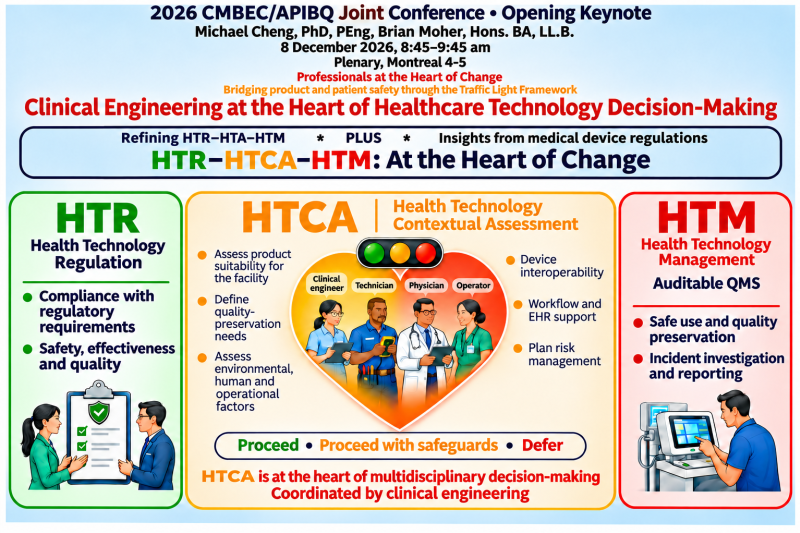
The central proposition is that the quality on which a medical device’s safety, effectiveness and performance depend must be preserved throughout clinical use. Understanding maintenance as a central component of quality preservation establishes a direct conceptual link between health technology regulation (HTR) and health technology management (HTM). Inspection, testing, calibration, maintenance and incident investigation help preserve or restore the conditions on which safe and effective patient care depends. This perspective makes the connection between clinical engineering’s technical activities and patient care explicit.
Preserving device quality is essential, but the local suitability of a regulator-authorized device must also be assessed: a device that meets its specifications may still be unsuitable for a particular healthcare setting. The proposed HTR–HTCA–HTM paradigm refines the established HTR–HTA–HTM sequence by making contextual suitability an explicit facility-level decision step. HTCA does not replace health technology assessment (HTA) but incorporates escalation to HTA when warranted. HTCA focuses on patient safety by assessing whether a device’s intended use and product specifications are appropriate for local clinical needs and facility conditions. The contextual assessment function now termed HTCA was explicitly represented in Chapter 49 of the second edition of the Clinical Engineering Handbook in 2020. It turns out that HTCA also serves the kind of facility-level assessment function encouraged by WHO’s 2025 HTA guidance.
HTCA brings clinicians, clinical engineers, administrators and procurement personnel together to assess whether a technology can deliver its intended benefit safely, effectively and sustainably under local conditions. As healthcare becomes more digital and interconnected, clinical engineering has a growing role in integrating technical evidence with clinical suitability, interoperability, cybersecurity and operational requirements. This contribution places clinical engineering at the heart of collaborative healthcare technology decision-making.
The proposed ten-element facility QMS organizes established practices into a coherent structure for device selection, safe use and lifespan management. It makes facility responsibilities systematic and auditable, providing a complementary quality management structure alongside the manufacturer’s QMS. Together, these systems support shared responsibility for device quality, safe use and patient protection throughout clinical use.
Clinical engineering can gain visibility by making its contribution to patient safety explicit: directly connecting HTR and HTM through quality preservation, guiding technology decisions through structured HTCA, and demonstrating accountability through an auditable facility QMS. Together, these contributions can transform how the profession is understood, engaged and valued.
About the Presenters

Michael Cheng, PhD, PEng
Michael Cheng has spent more than five decades in medical device safety, clinical engineering and international advisory work. After earning his Ph.D. in Biomedical Engineering from McGill University in 1972, he investigated adverse events at Health Canada’s Bureau of Medical Devices and, in 1977, founded the Biomedical Engineering Department at Ottawa General Hospital.
Since 1985 he has advised the World Health Organization, the World Bank and other agencies in nearly 30 countries, and developed WHO’s Medical Device Regulations: Global Overview and Guiding Principles (2003), widely known as the “Green Book.” His multi-professional work on a three-stage approach to medical device safety – now the Traffic Light Framework – appears in the Clinical Engineering Handbook (2nd ed., 2020).

Brian Moher, Hons. BA, LL.B.
Brian Moher is a lawyer whose practice has focused almost exclusively on health law, with a particular interest in medical devices and their regulation. He has extensive litigation experience in medical device class actions and cross-border litigation.
Outside of his legal practice, Brian works as a researcher, writer and speaker in clinical engineering, psychology, and public health law and policy.